
 English
 русский
 日本語
日本語 عربى
عربى Español
Content
- 1 What Is a Water Flow Limiter?
- 2 How Does a Water Flow Limiter Work?
- 3 Flow Limiter vs. Flow Restrictor vs. Flow Regulator vs. Balancing Valve
- 4 Where Water Flow Limiters Are Used in Everyday Water Equipment
- 5 Typical Flow Rate Values and Benchmarks
- 6 How to Choose a Water Flow Limiter
- 7 Flow Limiters in Water Bottle Pumps and Water Dispensers
- 8 Installation, Cleaning, and Common Mistakes
- 9 How to Measure the Actual Flow Rate of an Outlet
- 10 Water Flow Limiter FAQ
- 10.1 1. What is the difference between a water flow limiter and a pressure reducer?
- 10.2 2. Does a flow limiter reduce water pressure?
- 10.3 3. Can I remove the flow limiter from my dispenser faucet to get more water?
- 10.4 4. What flow rate should a water dispenser tap deliver?
- 10.5 5. How can I tell if the flow limiter is clogged?
- 10.6 6. Is a strainer really necessary before a flow limiter?
What Is a Water Flow Limiter?
A water flow limiter is a small inline component that keeps the flow through a pipe, hose, or fitting at or below a pre-set rate even when the inlet pressure changes. Unlike a shut-off valve, it never fully closes the line; unlike a pressure-reducing valve, it does not manage pressure as its main job. It simply throttles the stream so the outlet cannot exceed roughly the rated volume per minute. A limiter rated at 6 L/min, for example, will hold the output near 6 L/min at 1 bar, at 3 bar, and at 5 bar. Below that pressure window the limiter stays largely open and the system behaves normally; above it, the limiter takes over and flattens the flow curve.
The practical conclusion for buyers is simple: if you are repairing or specifying a water dispenser, a faucet, or a bottle pump, the flow limiter is the part that determines how fast water actually leaves the outlet. It influences splashing, the scalding risk of hot water taps, water consumption, the stability of beverage dispensing, and even the noise level of the appliance. Choosing the correct limiter is a functional decision, not just a plumbing detail.
How Does a Water Flow Limiter Work?
Two designs cover almost everything on the market: fixed orifice limiters and pressure-compensating limiters.
Fixed orifice type. This is a solid ring or washer with a precisely drilled hole. The hole diameter sets the maximum flow under a defined pressure. It costs little and works reliably, but the output still climbs as supply pressure climbs, so it is a restrictor rather than a true limiter.
Pressure-compensating type. This is the actual flow limiter used in showers, water dispensers, and modern appliances. Inside the body sits an elastomer disc or cup. When water enters, pressure pushes the disc toward a tapered channel. Higher inlet pressure bends the disc further and narrows the opening, so the flow stays almost constant. Most pressure-compensating limiters operate across a pressure range of roughly 0.5 to 6 bar, which covers normal household and commercial water supply.
The sequence inside a pressure-compensating limiter is short and effective:
- Water enters the inlet chamber and presses against the elastomer disc.
- At low pressure the disc lies nearly flat and the passage is wide.
- As pressure rises, the disc flexes toward the outlet and the gap narrows.
- The system reaches a balance where flow stabilizes at the rated value.
- If pressure drops again, the disc relaxes and the gap opens wider to hold the set flow.
The big advantage of this self-adjusting action is that the same limiter works on a weak gravity-fed supply and on a strong pump-fed line without flooding the outlet.
Flow Limiter vs. Flow Restrictor vs. Flow Regulator vs. Balancing Valve
These terms get mixed up constantly in product listings. The comparison below shows the real differences in working principle and behavior.
| Aspect | Flow limiter | Flow restrictor | Flow regulator | Balancing valve |
|---|---|---|---|---|
| Primary function | Caps flow at a set maximum | Adds a fixed resistance to flow | Normalizes flow to a set target | Balances flow between parallel branches |
| Working principle | Pressure-compensating elastomer disc | Fixed hole or washer | Spring or diaphragm mechanism | Adjustable restriction, set manually or automatically |
| Flow behavior vs. pressure | Nearly flat once the set point is reached | Continues to rise as pressure rises | Constant across the whole operating range | Changes with valve position and system balance |
| Splash and scald protection | High, stable even on strong supply | Partial, varies with pressure | High, designed for appliances | Not the primary purpose |
| Typical location | Dispenser taps, showerheads, faucets | Cheap faucet washers and aerators | Boilers, pumps, dishwashers | HVAC manifolds, multi-zone distribution |
In short, a restrictor is a passive washer, a limiter and a regulator both self-adjust, and a balancing valve does a different job entirely because it manages the split of flow after the main line has already been limited.
Where Water Flow Limiters Are Used in Everyday Water Equipment
You rarely see a flow limiter because it is hidden inside the fitting, but you notice it immediately when it is missing. The most common locations include:
- Water dispenser hot and cold taps. Anti-scald hot water taps rely on a limiter to keep hot water output slow enough for safe cup filling, typically below 1 L/min.
- Showerheads and bathroom faucets. Limiters are built into many showerheads to meet water-saving benchmarks and to avoid an aggressive spray.
- Kitchen and drinking faucets. A limiter inside the aerator holds the flow near 5.7 to 8.3 L/min depending on local norms.
- Electric bottle pumps and manual pumps. A limiter or narrow flow path prevents a 5-gallon bottle from gushing when the pump starts.
- Coffee urns and beverage dispensers. Push taps with lever handles include an integrated flow restriction so the cup does not overflow while the user watches the level gauge.
- Industrial process and cooling lines. Limiters protect filters, dosing pumps, and heat exchangers from excessive flow rates.
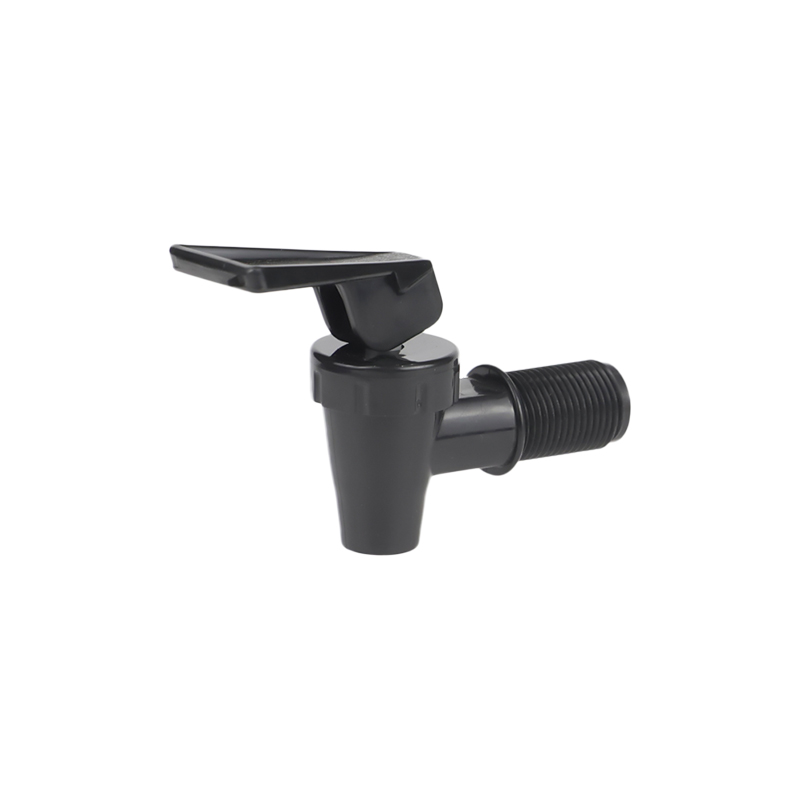
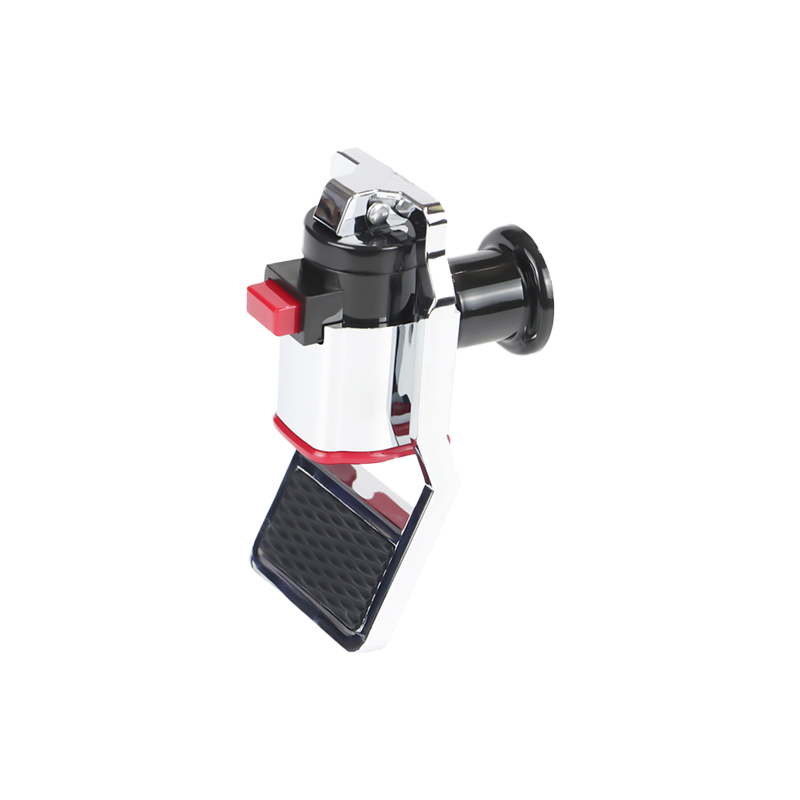
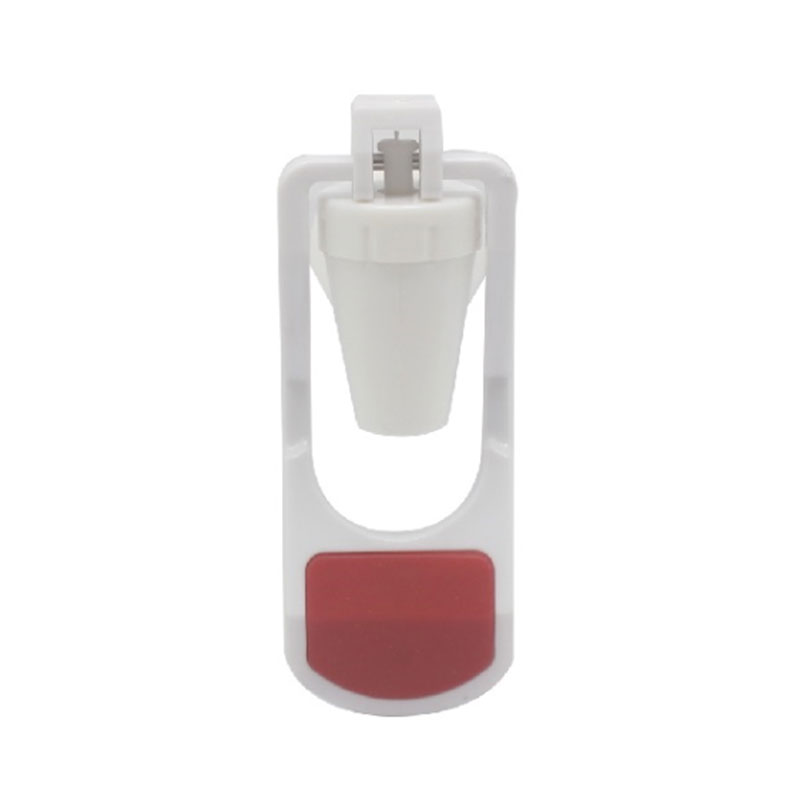 Push-Lever Water Dispenser Faucet for PurifiersThis faucet with a push lever is shown after common flow limiter locations are listed. Its compact build and customizable color make it a practical choice when replacing tap components that affect flow control.View Product →
Typical Flow Rate Values and Benchmarks
Flow limiter ratings are usually printed as L/min, GPM, or a code number that corresponds to a flow in gallons per minute. Knowing where the common benchmarks sit helps you read any catalogue correctly.
| Application | Typical limiter rating | Note |
|---|---|---|
| Showerhead, North American benchmark | 2.0 GPM (7.6 L/min) | EPA WaterSense reference value for showerheads |
| Kitchen faucet aerator | 1.5 to 2.2 GPM (5.7 to 8.3 L/min) | Common range for household faucets |
| Water dispenser cold tap | 1 to 3 L/min | Typical OEM specification for dispenser faucets |
| Water dispenser hot safety tap | 0.5 to 1 L/min | Low output prevents hot water splashing |
| USB water bottle pump | 1.5 to 3 L/min | Typical continuous output for 19 L or 5-gallon bottles |
| Syrup or food pump | 5 to 10 mL per stroke | Dosing pumps are rated per stroke, not continuous flow |
Source note: the 2.0 GPM showerhead figure comes from the EPA WaterSense specification. The dispenser and pump ranges are typical manufacturer values observed across water dispenser component specifications.
A rating is only meaningful when the pressure is stated. A fixed orifice that delivers 2 L/min at 1 bar may deliver 4 L/min at 4 bar, while a pressure-compensating limiter stays close to its printed value across the whole pressure range.
How to Choose a Water Flow Limiter
Start with the output you want, then match the connection. The quick answer is: pick the smallest standard rating that still gives a comfortable stream, select a food-grade material when the water is for drinking, and confirm the thread form before ordering.
- Connection size and thread form. Water dispenser taps commonly use M8, M10, M16, or M18 threads, while metal spigots often use 1/2 inch male threads. The limiter must fit the same bore, otherwise you will need an adapter.
- Target flow rate. Define the use first: a hot water safety tap works best around 0.5 to 1 L/min, a cold dispensing tap around 1 to 3 L/min, and a shower at 7.6 L/min or less.
- Operating pressure range. Confirm that the limiter is designed for the pressure at the installation point. Most pressure-compensating types cover 0.5 to 6 bar.
- Material and food safety. For drinking water, choose POM, PP, or food-grade silicone parts. Avoid unclear alloy materials when the component contacts water directly.
- Temperature resistance. Hot water lines need a limiter rated above 80 degrees Celsius. Standard plastic limiters may soften on steam or boiling water circuits.
- Cleaning and serviceability. Prefer designs where the limiter can be removed for descaling. Hard water will eventually coat the orifice and reduce output.
If you are sourcing multiple components for an assembled dispenser or drink station, the full product catalogue groups taps, pumps, tubes, and limiters by application so you can compare thread sizes and flow ratings in one place.
Flow Limiters in Water Bottle Pumps and Water Dispensers
For people who assemble, install, or repair water dispensers, the flow limiter is part of the whole water path: the bottle, the pump, the tube, and the tap. All four parts affect the final output rate.
Electric bottle pumps. Most USB rechargeable pumps pull water from a 19-liter or 5-gallon bottle. Without any flow limiting, the first seconds of a pump stroke push water out in a fast burst that splashes. Manufacturers therefore use a narrow outlet channel or a built-in limiter to keep the pump output in the 1.5 to 3 L/min range. This is why pumps with similar motors can show different delivery speeds: the limiter, not the motor, sets the sustained flow.
Manual bottle pumps. A hand pump releases a fixed volume per stroke, typically 80 to 150 mL depending on the cylinder size. A limiter is less common here; instead, the outlet tube diameter and the valve design control the burst size.
Hot water anti-scald taps. A dispenser hot tap with a child lock usually restricts the hot water flow to a low value to limit burn severity, combined with the push-and-turn mechanism. The limiter is the hidden safety layer that keeps the stream calm even when the tank is under full pressure.
Matching all path components matters. A pump rated for 2 L/min will deliver less if the tube is too narrow or the tap adds excessive resistance. Good practice is to size the tube and the tap so the limiter, not the piping, is the part that governs the flow. For a closer look at how pumps are selected and rated, this guide to electric water bottle pumps explains the role of delivery speed and bottle compatibility.
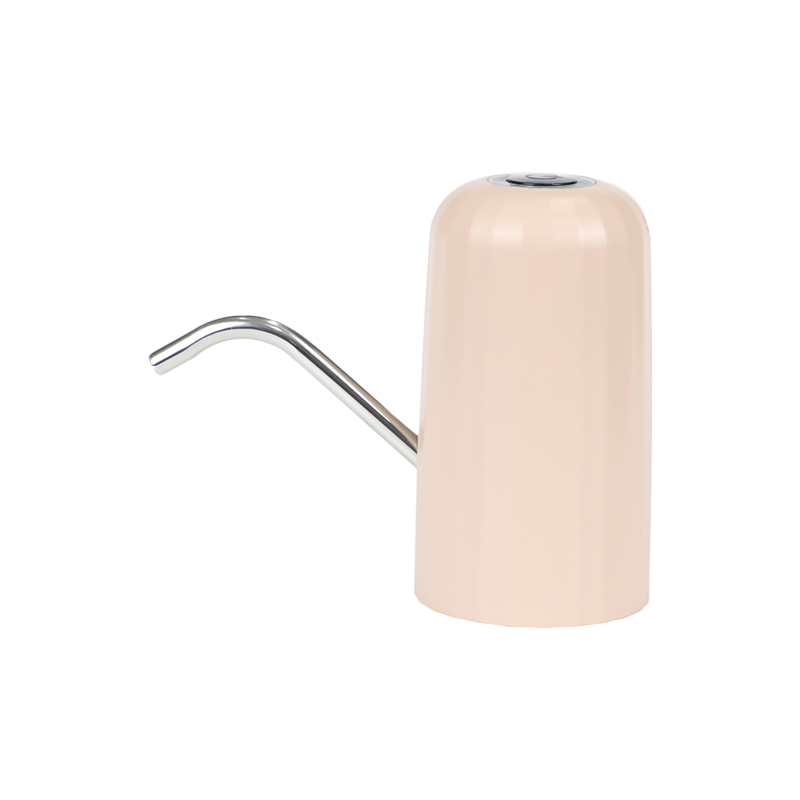 USB-C Rechargeable Electric Pump for 5-Gallon BottlesFeatured after a discussion on pump ratings and tubing resistance, this USB-C pump suits standard 5-gallon bottles, pumps about 1.2 liters per minute, and uses food-grade materials, making it relevant for anyone sizing a delivery system.View Product →
Installation, Cleaning, and Common Mistakes
Installing a flow limiter is generally a five-minute job when the housing is accessible. The correct sequence is:
- Turn off the water supply and drain the line.
- Remove the faucet outlet, aerator, or pump head where the limiter sits.
- Check the flow direction arrow on the limiter body; the tapered side faces downstream.
- Seat the limiter in the recess and press it home. Do not force a larger size into a smaller bore.
- Reassemble, open the supply, and confirm that the stream is even and stable.
Common mistakes that cause early failures include:
- Buying by look instead of by thread size, then using tape or glue that jams the limiter.
- Installing without an upstream strainer, letting scale and sediment block the orifice.
- Reversing the limiter so it behaves as a one-way choke instead of a compensator.
- Removing the limiter to improve flow, which increases splashing and scalding risk.
- Using non-food-grade materials on drinking water lines.
Flexible lines also affect the result. A food-grade silicone tube with a smooth bore reduces friction and keeps the limiter working at its rated output, while a wrinkled or mismatched hose adds resistance and can starve the outlet.
 Transparent Food-Grade Silicone Tubing for Beverage LinesPlaced before the segment on measuring output, this flexible, heat- and cold-resistant silicone hose with a smooth bore helps reduce friction so a flow limiter can perform at its rated level, and its clarity eases flow monitoring.View Product →
How to Measure the Actual Flow Rate of an Outlet
Measuring the output of a tap, pump, or dispenser takes less than two minutes and requires only a measuring jug and a timer:
- Get a 1-liter measuring jug and a stopwatch or a phone timer.
- Turn the tap or pump to full output.
- Collect water for exactly 15 seconds.
- Multiply the collected volume by 4 to get L/min.
- Repeat three times and average the results.
Interpreting the result: if the measured value is noticeably below the limiter rating, the limiter may be clogged or the supply pressure is too low. If it is above the rating, the limiter is missing, damaged, or the wrong part for the application.
Water Flow Limiter FAQ
1. What is the difference between a water flow limiter and a pressure reducer?
A flow limiter caps the volume of water passing per minute, while a pressure reducer lowers the pressure of the whole line. A limiter can even create a noticeable pressure drop across itself while the downstream flow volume stays unchanged.
2. Does a flow limiter reduce water pressure?
It creates a pressure drop, but its purpose is to stabilize flow. Downstream, the stream velocity falls because the volume per minute is held down; the static pressure inside the pipe may still be high.
3. Can I remove the flow limiter from my dispenser faucet to get more water?
Physically it is often possible, but the result is a faster, splashier stream, higher hot water scalding risk, and worse water conservation. The limiter is a designed-in safety and performance part, not a shipping plug.
4. What flow rate should a water dispenser tap deliver?
A cold drinking tap typically delivers 1 to 3 L/min. A hot water safety tap is usually limited to 0.5 to 1 L/min to reduce burn risk. These are practical OEM ranges commonly seen in dispenser specifications.
5. How can I tell if the flow limiter is clogged?
The classic symptom is weak or uneven output even with the tap fully open and the supply strong, plus a slow stream that never reaches its old rate. Clean or replace the limiter and also check the upstream filter or strainer.
6. Is a strainer really necessary before a flow limiter?
Yes. Scale, rust, and sand clog the small orifice quickly, especially on old pipes or well water. A simple inlet screen removes the problem before it reaches the limiter.