
 English
 русский
 日本語
 عربى
 Español
Content
- 1 Four Decisions That Define Any Faucet Type
- 2 Valve Types Compared: Ball, Cartridge, Ceramic Disc and Compression
- 3 Spout Shapes, Mounting Styles and Handle Counts
- 4 Dispenser and Water Cooler Taps: The Family Most Buyers Actually Need
- 5 Beverage, Coffee and Bulk Container Spigots
- 6 Bottle Taps and Pumps: Three Ways to Empty a 5-Gallon Bottle
- 7 Materials and Finishes: What Actually Changes in Daily Use
- 8 A Practical Selection Sequence for Buyers
- 9 Common Buying Mistakes and the Costs They Create
- 10 Which Faucet Type Fits Which Job
- 11 Frequently Asked Questions
- 11.1 Are water dispenser taps and kitchen faucets the same thing?
- 11.2 Which valve type lasts the longest?
- 11.3 What exactly is an anti-scald tap, and do I need one?
- 11.4 Can a single tap dispense both hot and cold water?
- 11.5 How do I measure for a replacement tap?
- 11.6 Do plastic taps make water taste different?
- 11.7 What size tap fits a standard 5-gallon bottle?
- 11.8 How often should a beverage spigot be cleaned?
A cafe owner we supply ordered six replacement spigots for his 20-litre beverage barrels. Two of them would not seal, even though both the barrels and the spigots were standard parts. Nothing was defective. The type was wrong: he had bought a spigot built for a thin glass dispenser wall, while his barrels were cut for a thicker gasket and a longer threaded shank.
That story is the practical problem behind "faucet types". A product photo tells you almost nothing. The valve inside, the way the spout delivers water, the control you touch, and the mount that ties the whole assembly to a sink, cooler panel, bottle neck or barrel tell you everything.
The short answer: every faucet or tap can be described by four decisions - the valve that controls flow, the spout that delivers water, the handle or control that actuates the valve, and the mount and connection that fix the assembly in place. Sort any product into those four boxes and you can compare it against anything else on the market in under a minute.
There is also a family split that generic guides tend to skip. Fixture faucets, the kind on kitchen and bathroom sinks, run off a pressurised supply line. Container taps and spigots - water cooler taps, bottle taps, juice and coffee spigots - run off gravity or a small electric pump. The two families share vocabulary and almost nothing else: different threads, different pressure assumptions, different safety concerns, and different failure modes.
Four Decisions That Define Any Faucet Type
Buyers who evaluate a faucet by its finish usually end up returning it. Buyers who evaluate it by these four attributes rarely do:
- Valve mechanism. The internal part that starts and stops flow. Ball, cartridge, ceramic disc and compression are the four mechanical families; dispensers add push-button and self-closing designs.
- Spout form. How and where the water leaves the body: pull-down, pull-out, gooseneck, low arc, straight spout, swivel, or a simple fixed barb outlet on a dispenser tap.
- Control configuration. Single lever, twin handles, cross handles, joystick, push button, or a two-step lift-and-turn safety control.
- Mount and connection. Deck mount through a 32-38 mm cut-out, wall mount, a 12-16 mm cooler-panel fitting, a 55 mm bottle-neck thread, or a barbed stem pushed into a silicone tube.
In our own production data, the single largest cause of replacement-part complaints is not the valve at all. It is the mount and connection: a half millimetre of thread difference, an undersized gasket, or a shank that is 5 mm too short for the panel thickness. Those details never appear in a headline specification, so they are the ones worth writing down before you order.
Valve Types Compared: Ball, Cartridge, Ceramic Disc and Compression
The valve determines how the tap feels in the hand, how long it lasts and how it is repaired. Comparison shopping gets much easier once you know which family you are looking at.
| Valve type | How it works | Handle motion | Strength | Weak point |
|---|---|---|---|---|
| Compression | Rubber washer is pressed onto a seat | Two handles, multi-turn | Cheap, simple, repairable with common washers | Washer wears and drips; no fine control |
| Ball | A ported ball rotates inside seats | Single lever, one-hand sweep | Fast temperature and flow mixing | Seats and springs are model specific |
| Cartridge | A moving cartridge slides or rotates in a housing | Single or dual handle | Whole unit swaps out in minutes | Plastic bodies stiffen with hard water |
| Ceramic disc | Two polished discs slide across each other | Quarter-turn lever | Very precise, long service life | Grit and scale score the disc faces |
| Push button or self-closing | Spring or diaphragm returns automatically | Press to dispense, release to stop | No tap left running; good for public and shared use | Lower flow; spring or diaphragm needs periodic replacement |
Ceramic disc valves dominate mid to high-end kitchen faucets because the quarter-turn motion is easy to use and the plates tolerate millions of cycles. Ball valves remain the default in simple single-lever designs and many plastic bottle taps, where the cost of a full cartridge assembly is hard to justify. Compression valves survive mainly in older plumbing and in utility taps where a washer is the only spare part anyone needs to stock.
Spout Shapes, Mounting Styles and Handle Counts
Spout form decides how usable a faucet is for the job in front of it. A low-arc spout is fine for a bathroom basin and hopeless for filling a stock pot; a pull-down head is wasted on a gravity-fed dispenser that never sees more than a trickle of pressure.
- Pull-down and pull-out. The head extends on a hose, usually 400-600 mm of travel. Pull-down heads sit high and drop downward; pull-out heads travel outward from a lower body.
- Gooseneck and tall arch. High clearance for large pots. Excellent for kitchens, awkward in low-clearance cabinets.
- Low arc and straight spout. Compact and inexpensive, common on basin faucets and on plastic container taps.
- Swivel spout. Rotates between two basins or two sides of a sink. Useful in shared kitchen sinks and on double-bowl dispensers.
- Pot filler. Wall mounted above the hob, folds away, saves carrying full pots across a kitchen.
- Side sprayer. An independent spray head, usually paired with a main spout on a three-hole sink deck.
Handle count and hole count go together
A single-handle faucet needs one hole, normally 32-38 mm in diameter. A two-handle setup needs two or three holes. A wideset faucet uses three holes spaced at roughly 203 mm (8 inches) between the outer centres, which is why it will not drop into a single-hole deck without a cover plate. Single-hole dual-handle designs exist as a compromise: one mounting hole, two small handles on the body. Measure the existing hole pattern with a ruler before shortlisting anything, because no adapter will fix a 4-inch pattern on an 8-inch deck.
Dispenser and Water Cooler Taps: The Family Most Buyers Actually Need
If the water comes out of a cooler cabinet rather than a plumbed sink, you are shopping in a different category. Cooler taps mount through a panel roughly 12-16 mm thick, connect to the internal tank through a barbed stem and a silicone tube, and are usually fed by gravity or a small pump rather than mains pressure. Flow is modest by design, and the hot side creates the safety problem that shapes the whole category.
Water from a hot tank can leave the spout far above the temperature a hand expects. Anti-scald taps solve this with a two-step motion, often a lift-and-turn or a push-and-slide, so a casual brush against the lever does not release hot water. Several models add a child safety lock on top of that, which is why they cost more than a plain tap and why they are standard on family-oriented coolers.
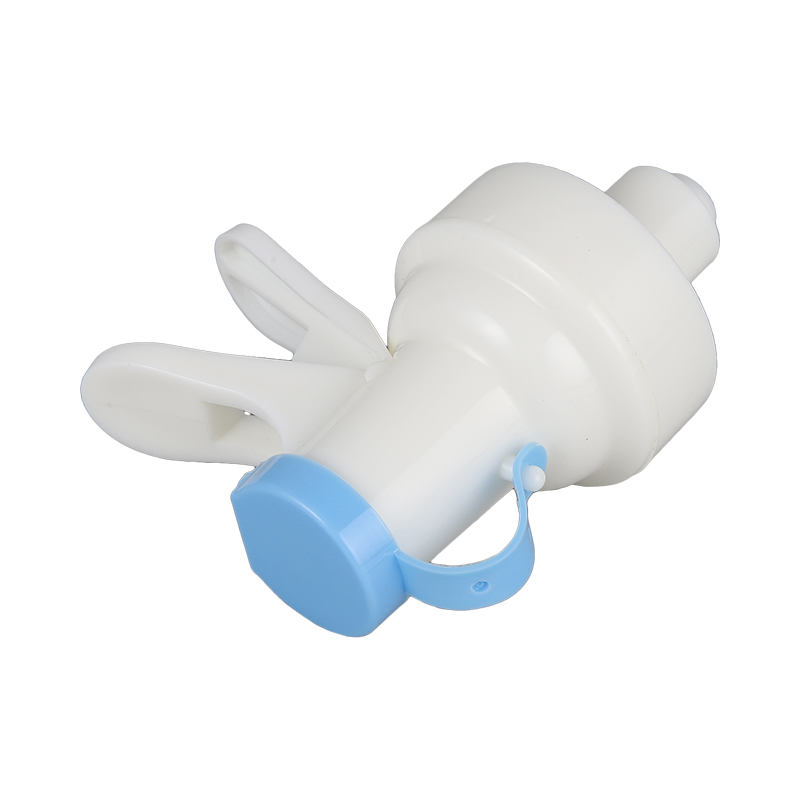
 Water Dispenser Plastic Tap Drinking dispenser-M8 SafetyDetails & specificationsView Product →
Beyond safety, the cooler tap range splits into a handful of recognisable designs:
- Twin hot and cold taps. Two bodies on one panel, cold on one side and hot on the other, each with its own lever.
- Push-type taps. Press to dispense and the valve closes on release. Popular in offices and public areas because nobody leaves a tap running.
- Electroplated plastic taps. A chrome-look finish over a moulded body. The look is worth the money only if the plating adheres properly; poor plating blisters within months on the hot side.
- Coin-operated ball valve taps. Found on paid drinking fountains and vending-style coolers, where a timer or coin mechanism drives a ball valve.
- External plastic taps. Bolt-on replacements for coolers with the tap mounted outside the cabinet face.
One caution for anyone sourcing on price alone: in our experience, the temperature difference between a well-sealed hot tap and a cheap one shows up at the seals, not the body. A gasket that hardens at high temperature starts weeping within a season, and the resulting drip stains the cooler panel and reaches the electrics underneath.
Beverage, Coffee and Bulk Container Spigots
Beverage spigots share the same anatomy as cooler taps but are sized for larger containers: glass jars, stainless barrels, juice dispensers, mini kegs, coffee urns and picnic jugs. Because they handle drinks with sugar, acid and pulp, two details matter more than anything else - the bore diameter and how easily the body comes apart for cleaning.
Bore diameter is the single biggest lever on pour speed. Flow area rises with the square of the bore, so moving from a 6 mm to a 10 mm bore roughly triples the opening. On a gravity-fed dispenser with a low head of liquid, that is the difference between a slow dribble and a confident pour.
 Stainless steel mini keg tap dispenser A BODA 19Details & specificationsView Product →
The main spigot variants on the market break down like this:
- Metal spigots. Stainless steel or plated bodies for juice dispensers, glass jars and mini kegs. Stable in hot and cold drinks, and far easier to sanitise than a textured plastic body.
- Coffee urn spigots with a level gauge. A sight glass or gauge beside the tap lets staff read the remaining volume without opening the urn, which cuts spills and re-brewing errors during service peaks.
- Push-type beverage taps. A spring-loaded plunger lets a bartender pour one-handed while holding a glass, which is exactly why they are common on draft and keg setups.
- Barrel or wine-set taps. Compact plastic bodies with a small button, used on wine boxes, vinegar drums and tabletop drinks sets.
- Syrup and jam pumps. Not a tap at all in the mechanical sense, but part of the same dispensing family. Portion sizes such as 5 cc and 8 ml per stroke come straight from the pump chamber volume, which is why they are specified by dose rather than by flow rate.
Cleaning access is the second deciding factor. A spigot held together by a press fit cannot be fully disassembled, so sugar residue builds in the joint and the taste of yesterday's juice shows up in today's water. Any spigot used with anything other than plain water should come apart with a quarter turn or a single nut.
Bottle Taps and Pumps: Three Ways to Empty a 5-Gallon Bottle
Bottled water introduces a third family. Standard 5-gallon and 19-litre bottles share a 55 mm neck thread, which is why so many screw-on taps, racks and stands are interchangeable across brands. There are three broad approaches, and each suits a different setting.
- Screw-on bottle taps. The bottle is inverted onto a stand or rack and the tap threads directly onto the neck. Zero power, zero noise, and a straightforward replacement part when the gasket finally gives up.
- Manual pressure pumps. A hand-pressed pump on top of an upright bottle pushes water up a tube and out of a spout. No electricity and no lifting, which is why they stay popular for camping, workshops and markets.
- USB rechargeable pumps. A battery-powered unit clips onto the neck and dispenses at the touch of a button. Published specifications for these units typically sit in the range of a few litres per minute on a charged cell, and most accept a standard USB charging lead.
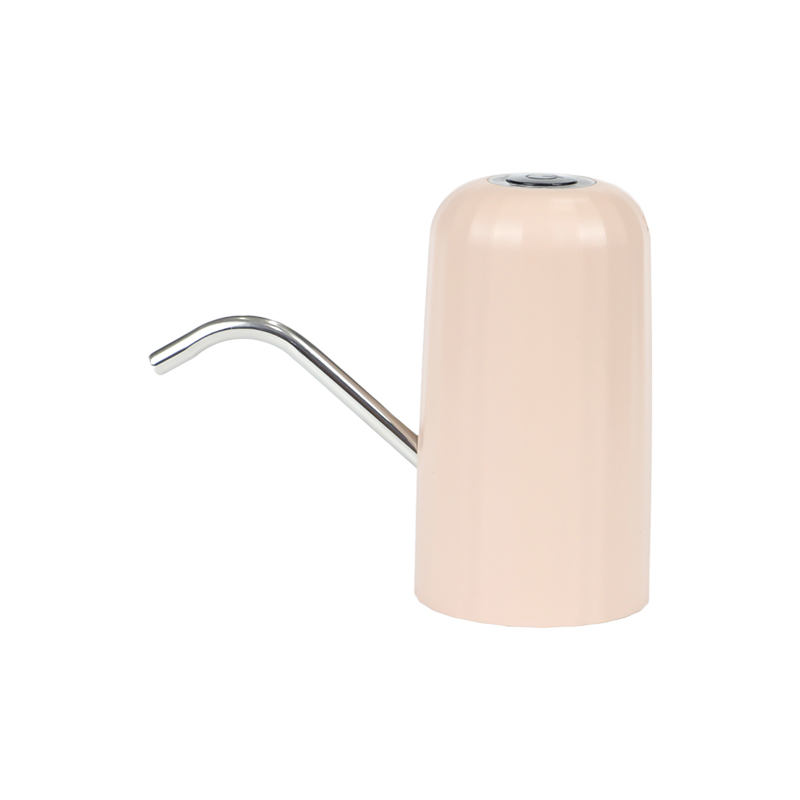 USB rechargeable electric automatic pump water USB-CDetails & specificationsView Product →
Two practical notes. First, a pump that clips over the neck and a tap that threads into it are not mutually exclusive - many stands are sold with both. Second, hygiene depends on whether the pump can be taken apart. A unit that cannot be opened will collect a film inside the tube within weeks, and no amount of rinsing the outside will fix that.
Materials and Finishes: What Actually Changes in Daily Use
Material choice sits behind most of the differences buyers notice after installation, from how the tap feels to how long it looks presentable.
- ABS and PP plastics. Light, non-corroding and low cost. They do not transfer heat, so a plastic hot tap stays safer to touch. They scratch, and a moulded body cannot be re-polished.
- Electroplated plastic. A chrome-look shell over a plastic core. The visual result can match metal closely, but adhesion quality decides the lifespan, especially on the hot side where thermal cycling stresses the plating.
- 304 stainless steel. An austenitic grade containing roughly 18 percent chromium and 8 percent nickel, which is why it resists rust in damp kitchens and in contact with acidic drinks. It is also widely chosen for drinking-water contact parts.
- Zinc alloy and brass. Heavy and rigid, with a solid feel in the hand. Both normally need a plated finish, and both are a poor fit for continuously hot water if the finish fails.
- Food-grade silicone tube. The flexible link between tank, pump and tap. Supplier data sheets commonly quote service temperatures from about minus 40 degrees Celsius to 200 degrees Celsius, which covers everything from iced drinks to near-boiling water.
A quick field test for plating quality: look at the inside of the spout and the underside of the handle, not the front face. Those are the areas that get the thinnest deposit, and they are the first to show pitting or a dull grey patch.
A Practical Selection Sequence for Buyers
Working through these steps in order prevents almost every mismatch we see in incoming enquiries.
- Identify the source. Plumbed supply line means a fixture faucet. Bottle, barrel, urn or tank means a container tap or pump.
- Confirm hot, cold or mixed, and note the highest temperature the tap will see in normal service.
- Measure the mounting point. Hole diameter, panel thickness and thread specification, to the nearest half millimetre.
- Set a flow target. A pressurised kitchen faucet and a gravity-fed dispenser have completely different realistic flow rates, so do not compare them on the same number.
- Choose the valve family based on how the tap will be used, not on how it looks in a photograph.
- Decide whether a safety control is required. Any shared dispenser serving hot water benefits from anti-scald geometry.
- Check the material against the liquid. Sugary, acidic and dairy-adjacent drinks demand a body that disassembles for cleaning.
- Ask what spare parts exist. A tap without a listed gasket or valve kit becomes a full replacement the first time it drips.
- Order one sample and test it on the real container before committing to a batch quantity.
Step nine is the one buyers skip most often, and it is the cheapest insurance in the whole process. A single unit tested against the actual panel, gasket and liquid will reveal a sealing problem that no specification sheet mentions.
Common Buying Mistakes and the Costs They Create
Most of the expensive errors in faucet and tap sourcing trace back to a handful of repeated assumptions.
- Buying from a photo. Two taps that look identical can differ in thread, shank length and gasket depth.
- Mixing thread standards. A G-thread and a tapered thread will not seal against the same boss, and forcing one damages both parts.
- Treating chrome finish as a material. A plated plastic body and a stainless steel body can carry the same colour and completely different service lives.
- Forgetting the seals. A tap shipped without its gasket set cannot be installed on arrival, and a mismatched gasket is the number one cause of a drip on day one.
- Applying kitchen faucet numbers to dispensers. Flow figures quoted for pressurised faucets mean nothing on a gravity-fed bottle stand.
- Standardising too early. A single tap model across every cooler and barrel in a building sounds efficient until the hot units start failing at the seals.
If you want the vocabulary settled before you talk to a supplier, this plain-language walkthrough of the main faucet types covers the same ground from a factory-floor angle. Reading it takes five minutes and saves a round of samples.
Which Faucet Type Fits Which Job
The same question - "what type should I buy?" - has a different answer depending on where the water is going to come from and who is going to use it.
| Installation | Best-fit type | Deciding detail |
|---|---|---|
| Home kitchen sink | Single-handle ceramic disc, pull-down or gooseneck | Spout clearance above the tallest pot |
| Office or plant water cooler | Twin hot and cold push-type taps | Self-closing action and panel hole size |
| Family home cooler | Anti-scald tap with child lock | Two-step control geometry, gasket heat rating |
| Cafe juice or drink dispenser | Stainless steel metal spigot | Bore diameter and full disassembly for cleaning |
| Coffee urn or buffet station | Coffee urn spigot with level gauge | Sight glass readability during service peaks |
| 5-gallon bottle at home | Screw-on bottle tap on a rack | 55 mm neck thread and stand stability |
| Camping or market stall | Manual pressure pump or collapsible jug tap | No power source required |
| Syrup or sauce service | Portion pump, 5 cc or 8 ml per stroke | Dose accuracy and food-grade contact parts |
Notice how rarely the finish appears in the deciding column. It matters for the first impression and for resale value, but it does not decide whether the tap fits, seals or lasts.
Frequently Asked Questions
Are water dispenser taps and kitchen faucets the same thing?
No. A kitchen faucet mounts through a 32-38 mm deck hole and runs on supply-line pressure. A dispenser tap mounts through a much smaller cooler panel opening, connects internally through a barbed stem and silicone tube, and works on gravity or a small pump. Their threads, seals and flow expectations are different, so parts are rarely interchangeable.
Which valve type lasts the longest?
Ceramic disc valves generally outlast the alternatives because there is no rubber component flexing on every use. That advantage disappears in hard water, where scale grit scores the disc faces. In mineral-heavy areas, a cartridge valve that can be swapped as a complete unit often delivers a longer practical service life.
What exactly is an anti-scald tap, and do I need one?
An anti-scald tap requires a deliberate two-step motion to release hot water, so an accidental nudge on the lever does not dispense near-boiling water. If the cooler serves children, elderly users or the general public, the extra cost is easy to justify. Many models add a child safety lock as a second layer.
Can a single tap dispense both hot and cold water?
Yes, but on coolers this usually means two separate bodies - one hot, one cold - sharing a panel rather than one mixing valve. Mixing on a cooler is uncommon because the two tanks are independent. On pressurised fixtures, a single-handle mixing valve handles both from one lever.
How do I measure for a replacement tap?
Record four numbers: the mounting hole diameter, the panel or deck thickness, the thread specification on the shank, and the distance from the mounting face to the outlet. Then photograph the old tap from the side and from underneath, with a ruler in frame. Those four measurements plus two photos resolve the vast majority of replacement enquiries.
Do plastic taps make water taste different?
A moulded body made from a food-grade resin does not impart taste on its own. Off-flavours usually come from residue trapped in a joint that cannot be opened for cleaning, or from a silicone tube that has absorbed the aroma of a previous drink. Cleaning access matters more than the material label.
What size tap fits a standard 5-gallon bottle?
Standard 5-gallon and 19-litre bottles use a 55 mm neck thread, and most screw-on bottle taps and racks are built to that dimension. Bottles outside that standard, including some 3-gallon formats, need an adapter or a dedicated tap, so verify the neck before ordering in quantity.
How often should a beverage spigot be cleaned?
Daily flushing is the practical baseline for anything dispensing juice, milk-based drinks or syrup, with a full disassembly and wash at the end of each service day. Plain-water taps tolerate a longer interval, but any tap handling sugar should be treated like the drink line it is.
Sorting faucet types comes down to something refreshingly mechanical. Find out where the water is coming from, how hot it gets, what hole it has to pass through and who will be pressing the lever. The answers point to a small set of designs, and the rest of the catalogue falls away.
We build these parts rather than only describing them. Yuyao-based Yuyao Boda Electrical Appliances has focused on drinking-water equipment components for years, and according to the company's own published profile, it runs 18 plastic injection machines with 100-500 g shot capacity, 8 vertical moulding machines for cable production, 10 rubber water-pressure forming machines and a small circuit board line - the combination that allows a tap, a silicone hose, a pump and a cup holder to leave the same factory as one matched set. The published profile also records 49 standard export containers of dispenser parts as far back as 2002, exports into Southeast Asia and the Middle East including India, Turkey and the UAE, and a claimed domestic share above 60 percent for its main products.
If you are replacing a single tap or specifying a new cooler programme, the fastest route is to send the four measurements from the checklist above together with a photo of the old part. If you would rather browse first, the full parts catalogue lists taps, spigots, pumps, handles, stands, cup holders and food-grade tubing by family, so you can compare like with like before contacting anyone.